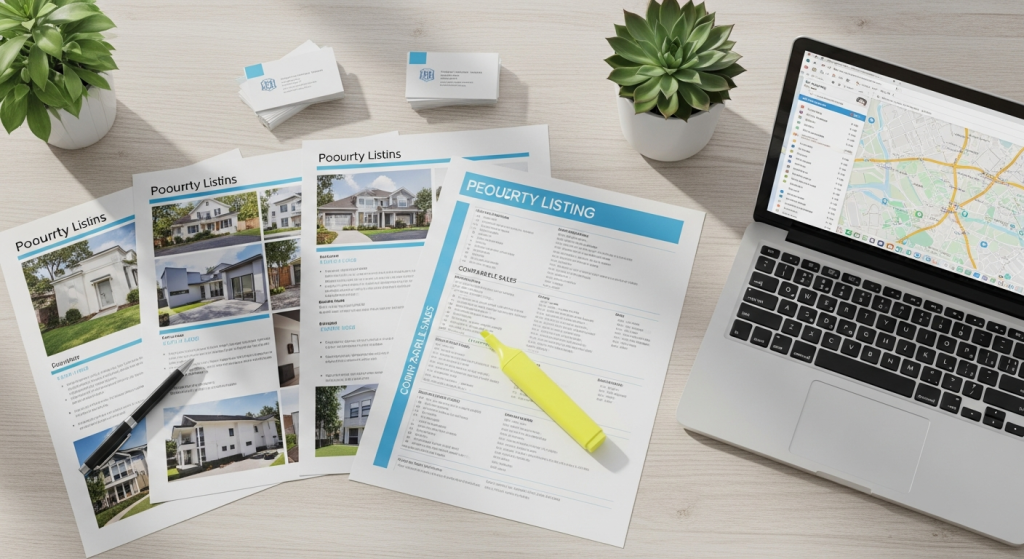
Comps Are the Foundation of Every Deal
Every number in your deal analysis flows from one starting point: the comparable sales you use to estimate property value. Get your comps right, and your ARV is accurate, your offer is sound, and your profit projection is reliable. Get them wrong, and everything downstream is flawed — no matter how perfectly you execute the renovation or negotiate with the seller.
Most investors learn the basics of pulling comps early in their careers. But the difference between a beginner comp analysis and a professional one can mean tens of thousands of dollars in accuracy. At Real Estate Sales LLC, we teach our students to analyze comps at a professional level — because precision in this skill directly translates to profit.
The CMA Framework
A Comparative Market Analysis (CMA) is the systematic process of evaluating recently sold properties to determine the market value of a subject property. Here is the professional framework:
Step 1: Define Your Subject Property
Before you pull comps, clearly define what your subject property will look like after renovation. Your comps need to match the finished product, not the current condition. Note the property type, square footage, bedroom and bathroom count, lot size, year built, and the level of finishes you plan to install.
Step 2: Set Your Search Parameters
Location radius: Start with a half-mile radius in the same neighborhood or subdivision. If you cannot find enough comps, expand to one mile — but stay within the same school district and general area character. Never cross major boundaries (highways, rivers, railroad tracks, commercial zones) that create different micro-markets.
Time frame: Use sales from the last 90 days as your primary comps. In slow markets, you may need to extend to 180 days. In fast-moving markets, prioritize the last 30 to 60 days. The more recent the sale, the more relevant it is.
Property characteristics: Match your subject property as closely as possible — same property type, within 200 square feet, same bedroom and bathroom count (plus or minus one), similar lot size, and similar age and construction type.
Step 3: Pull and Filter Comps
Pull every sale that meets your parameters, then filter systematically:
Eliminate outliers. Sales that are significantly above or below the cluster are often anomalous — estate sales, REO dispositions, interfamily transfers, or properties with unique features that do not apply to your subject. Note them but do not include them in your analysis.
Prioritize renovated comps. Since you are estimating the value of your property after renovation, prioritize comps that are in renovated or updated condition. A dated property that sold as-is is not comparable to your finished product.
Check the photos. MLS photos reveal the quality of finishes, the condition of the property, and details that the data does not capture. A property listed as “renovated” with builder-grade finishes is not comparable to your property with quartz countertops and luxury vinyl plank flooring.
Step 4: Make Adjustments
No comp is a perfect match. You need to adjust for differences between each comp and your subject property:
Square footage: Calculate the price per square foot from your comps and apply it to your subject. Also consider that value per square foot often decreases as size increases — a 1,200 sq ft home may sell for $150/sq ft while a 2,000 sq ft home in the same area sells for $130/sq ft.
Bedrooms and bathrooms: An additional bedroom typically adds $5,000 to $15,000 depending on the market. An additional bathroom adds $5,000 to $10,000. Adjust your comps accordingly.
Lot size: In suburban markets, lot size premiums range from $1,000 to $5,000 per additional quarter acre. In urban markets, lot size differences have less impact.
Garage: A garage adds $10,000 to $25,000 in most markets. If your subject has a garage and the comp does not (or vice versa), adjust.
Condition and finishes: This is the most subjective adjustment. A property with high-end finishes (quartz counters, hardwood floors, custom tile work) will sell for more than one with basic finishes (laminate counters, carpet, standard tile). Estimate the premium based on the quality gap.
Age and updates: Newer construction typically commands a premium. If your comp is 10 years newer or older than your subject, factor in the age difference — newer roofs, HVAC systems, and plumbing are worth more.
Step 5: Reconcile and Conclude
After adjustments, your comps should cluster around a value range. Use the median of your adjusted comps as your ARV estimate — not the highest and not the average (which can be skewed by outliers).
If your adjusted comps show a wide range (more than 10 percent spread), your analysis needs refinement. Either find better comps, make more precise adjustments, or acknowledge the uncertainty and use the lower end of the range for safety.
Advanced Techniques
Pending sales analysis. Active pending sales (under contract but not yet closed) reflect what buyers are willing to pay right now. While you do not know the final sale price, the listing price of a pending sale in a balanced market is a good indicator of current value.
Active listing analysis. Current active listings represent your competition. If comparable properties are listed at $250,000, pricing your flip at $275,000 is unrealistic. Active listings set the ceiling; closed sales confirm the floor.
Absorption rate. How quickly are comparable properties selling in your area? Divide the number of sales in the last six months by six to get the monthly absorption rate. Compare this to the number of active listings. If there are 10 active listings and 2 sales per month, you have 5 months of inventory — a buyer’s market. This affects both your ARV and your expected selling timeline.
Regression analysis. For data-oriented investors, plotting price per square foot against square footage on a scatter chart reveals the relationship between size and value in your market. This helps you make more accurate size-based adjustments.
Common Comp Mistakes
Cherry-picking the highest sale. Using the highest comp to justify your projected ARV is wishful thinking, not analysis. Use the median and let the data guide you.
Using comps from different neighborhoods. A sale one mile away in a better school district is not a comp — it is a fantasy. Stay within the same micro-market.
Ignoring condition differences. A comp that was newly built is not comparable to your 1970s renovation, even if the square footage and bedroom count match. Condition matters enormously.
Using stale data in a moving market. In a rapidly changing market (up or down), six-month-old comps are unreliable. Prioritize recent sales and adjust for the market direction.
Put This Into Practice
Comp analysis is a skill that improves with practice. Analyze properties in your target market regularly — even if you are not buying. Over time, you will develop an intuitive sense for values that makes your deal analysis faster and more accurate.
At Real Estate Sales LLC, deal analysis is a core component of our training. Our students learn to evaluate properties with confidence, using the same techniques that experienced professionals rely on.
Ready to sharpen your skills? Register for our free Flip Cheap Houses webinar and learn the complete system for analyzing and closing profitable deals.