Downturns Create the Best Buying Opportunities
Warren Buffett’s famous advice — be greedy when others are fearful — applies nowhere more powerfully than in real estate. Economic downturns flood the market with distressed properties from owners who can no longer afford their payments, investors who overleveraged, and banks trying to clear their books. For investors with cash, knowledge, and courage, these periods create generational wealth-building opportunities.
But not every distressed property is a deal. Some are money pits disguised as bargains. The difference between opportunity and trap comes down to your ability to analyze the property, the market, and the risks involved. At Real Estate Sales LLC, we teach our investors how to evaluate distressed properties with clear eyes and sound analysis.
Types of Distressed Properties in a Downturn
Pre-foreclosures. Homeowners who have fallen behind on their mortgage payments and received notice from their lender. These owners are racing against the clock — if they cannot catch up or find a solution, the bank will foreclose. This urgency creates motivation to sell at a discount in exchange for a fast, certain closing.
Foreclosures (REO). Properties that have completed the foreclosure process and are now owned by the bank (Real Estate Owned). Banks are not in the business of owning real estate — they want these properties off their books. REO properties are often sold below market value, sometimes significantly so.
Short sales. Properties where the homeowner owes more than the property is worth. The lender agrees to accept less than the full mortgage balance, and the property is sold at a discount. Short sales can be excellent deals, but they require patience — lender approval can take months.
Auction properties. Properties sold at courthouse auctions or online auction platforms. Auction properties can offer deep discounts, but they come with risks — limited or no inspection access, title issues, and the requirement to pay in cash (usually within 24 to 48 hours).
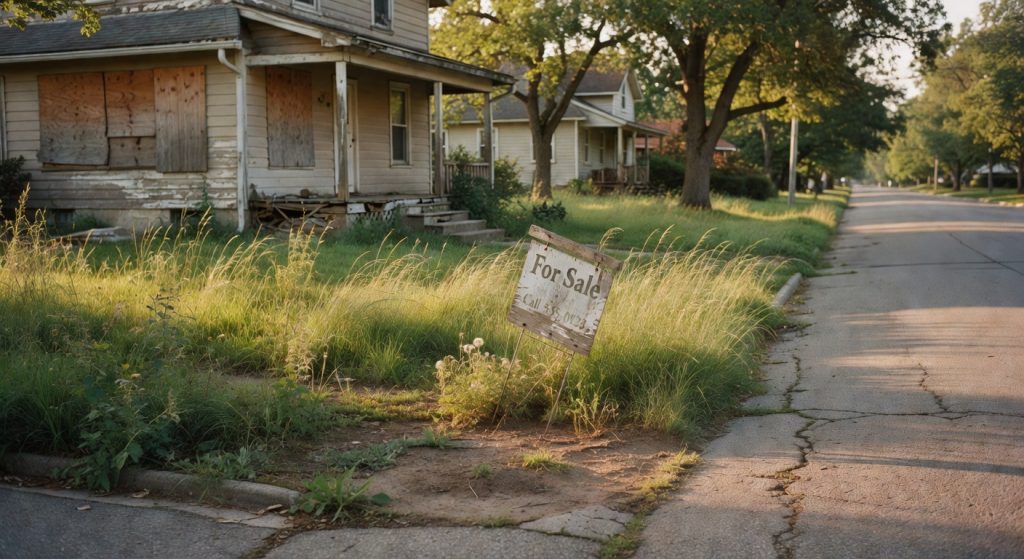
Abandoned properties. During downturns, some owners simply walk away from their properties. These can be acquired through negotiations with the mortgage holder, tax sales, or by tracking down the owner directly.
How to Evaluate Distressed Properties
Start with the ARV. Regardless of how cheap the property appears, the After Repair Value determines whether the deal works. If the ARV does not support a profitable deal after accounting for purchase price, renovation costs, and holding costs, pass — no matter how distressed the property is.
Get accurate repair estimates. Distressed properties often need more work than they appear to need. What looks like cosmetic damage might hide structural issues, mold, outdated electrical, or failing plumbing. Always get a thorough inspection and build a contingency buffer of 15 to 20 percent into your renovation budget.
Research the title. Distressed properties frequently have title complications — multiple liens, back taxes, judgment liens, and outstanding HOA assessments. These costs must be factored into your offer price. Order a preliminary title search before committing to any distressed property purchase.
Assess the neighborhood trajectory. A distressed property in a recovering neighborhood is a completely different investment than one in an area that is still declining. Look for signs of stabilization — new construction, decreasing vacancy rates, improving schools, and infrastructure investment.
Understand the timeline. Some distressed deals close quickly (pre-foreclosures, auctions). Others take months (short sales, REO negotiations). Match your strategy and financial capacity to the expected timeline.
The Opportunity Side
Deep discounts. During downturns, distressed properties can sell for 20 to 50 percent below market value. These discounts create built-in equity from day one and provide the profit margin that makes your investment worthwhile.
Volume. Unlike a hot market where distressed properties are rare, downturns create an abundance of them. You have more options, more negotiating power, and the ability to be selective about which deals you pursue.
Long-term appreciation. Properties purchased at the bottom of a market cycle benefit from the inevitable recovery. Investors who bought distressed properties in 2009 and 2010 saw their values double or triple over the following decade.
Rental demand. Economic downturns typically increase rental demand as potential homebuyers delay their purchases. If you buy distressed properties and convert them to rentals, you benefit from strong demand and the eventual appreciation when the market recovers.
The Risk Side
Catching a falling knife. Buying too early in a downturn means the property may continue to decline in value after you purchase it. This is not a long-term problem if you are cash-flowing, but it can be painful for flippers who need to sell at a specific price.
Hidden damage. Vacant and neglected properties deteriorate quickly. Water damage from a leaking roof can lead to mold, which can lead to structural damage. What appeared to be a $30,000 renovation can balloon to $60,000 or more once you start opening walls.
Financing challenges. Lenders tighten their standards during downturns. Properties in poor condition may not qualify for traditional financing, limiting you to cash or hard money (which is more expensive). Some hard money lenders also become more conservative, requiring more equity or experience from borrowers.
Slow resale. If your exit strategy is to sell, be prepared for longer marketing times. Buyers are cautious during downturns, and the pool of qualified buyers shrinks as lending standards tighten.
Neighborhood decline. Not every neighborhood recovers from a downturn. Areas that were marginal before the downturn may slide further. Multiple foreclosures on a single block can create a negative spiral of declining values and increasing vacancy.
Mitigating the Risks
Buy deep. The deeper your discount, the more room you have for unexpected costs, market declines, and extended timelines. In a downturn, the 70 percent rule might need to become the 60 percent rule.
Inspect thoroughly. Never skip inspections on distressed properties. Pay for a full inspection including sewer scope, mold testing, and structural assessment. The cost of inspection is tiny compared to the cost of a surprise during renovation.
Have multiple exit strategies. If you cannot sell, can you rent? If you cannot rent, can you wholesale? Having backup plans ensures you can profit regardless of how the market moves after your purchase.
Focus on fundamentals. Buy in neighborhoods with strong employment, good schools, and stable demographics. These areas recover faster and more completely than areas without those fundamentals.
Keep reserves. Cash reserves give you the ability to weather unexpected costs, carry properties through slow periods, and take advantage of additional opportunities that arise.
The Bottom Line
Distressed properties during a downturn represent some of the best wealth-building opportunities in real estate — but only for investors who approach them with education, discipline, and realistic expectations. The key is thorough analysis, conservative projections, and the courage to act when others are paralyzed by fear.
At Real Estate Sales LLC, we prepare our investors to succeed in every market environment. Our mentoring program gives you the skills, confidence, and support to navigate uncertainty and turn challenging markets into profitable opportunities.
Ready to learn more? Register for our free Flip Cheap Houses webinar and discover how our investors are thriving — regardless of market conditions.